

Post Photography with Yola Monakhov
at Galeria E.V.A.
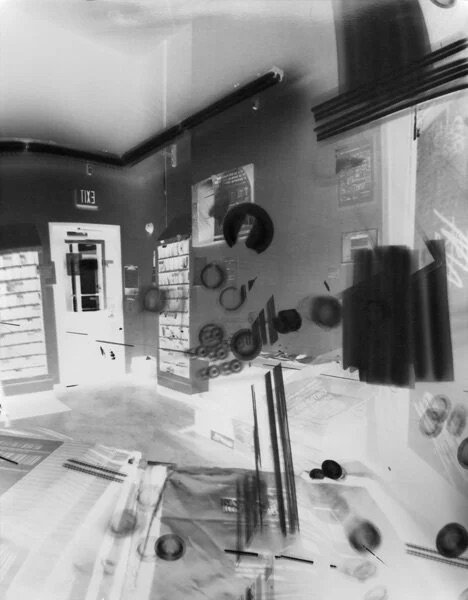
Join P&L for an evening with artist Yola Monakhov—whose work considers land relations, migration, and community practice through photography and film—as we explore Post-Photography, an ongoing camera obscura project that transforms the postal system into both camera and collaborator.
For more than a decade, Yola has mailed light-sensitive packages across cities, landscapes, and communities, allowing images to emerge through chance, movement, and exchange. The resulting works invite us to reconsider how we see, how we connect, and what it means to inhabit a place together.
Part artist talk, part conversation, and part communal gathering, this event will offer a chance to engage with Yola's work and the questions that animate it: What is gained when we slow down? How do images help us make meaning? And what forms of connection remain possible in an increasingly mediated world?
We hope your whole family join us for an evening of exploring ideas of connection, exchange, place, and the mystery of seeing, all in the spectacular setting of one of San Antonio’s most special spaces—Galeria E.V.A., founded in 2014 by Veronica Castillo, an internationally acclaimed artist from Izúcar de Matamoros, Puebla, México.
Artist Statement
The letter from the postmaster instructed me to stop. There was too much danger of glimpsing the inner workings of the postal system, and too many privacy concerns. Publicly available images existed already. Why make new ones?
The novelty question sits differently thirteen years later, against slopification and social media malaise. Why do we make new ones?
When I mailed the first box from Massachusetts and gave away the secret to my process—loading a box with photo-sensitive material, which allows a dim cone of light to enter the box via a pinhole—I didn’t foresee that this project would take so long.
I’d left my baby at home to run out to mail the package. The baby wasn’t yet heavy, not yet standing at six feet, as he does now, nor did he yet have a brother. Travel had become difficult, street photography nearly impossible. I was working as a visiting professor at a small liberal arts college, and this pinhole camera would be my proxy. An agent. An actor. Even, another being. I could put it to work, and accomplish so much!
Sometimes, I used color film in the box, a small sheet, where the glare of late morning sun drew lines on the picture plane. Such squiggles were ringed with purple, the result of differing wavelengths of refracted light. Other times, I worked with darkroom paper. Ample sheets loaded in a trapezoidal Apple iMac box, creating compositions with a tilt-shift effect. Those paper prints were unique, haptic, their tonal values reversed. Fluorescent light fixtures came alive black as ink.
This process is based on the principle of the camera obscura, one of the oldest optical devices thought to have been rediscovered by Renaissance artists. They used it as an aid in humanist perspective on architectonic space. Humanist because the lines of buildings converge to a point as seen by the human eye. Albeit this eye must be a monocular one, a Quattrocento cyclops, half-monster. There is nothing natural about this form of vision. Indeed, it would be just as true to see the world as a Chinese landscape painter would, the land below unfurling like a scroll beneath a bird.
In the visual language of this project, titled Post-Photography simply because photographers love puns, one may glimpse echoes of Soviet Constructivism, action painting, or Minimalism. One may also shed a tear for the public institutions which recede in the distance of nation states and other democratic ideals. If one were to pause and wax philosophical, and briefly recall Vilém Flusser’s “playing against the apparatus,” one could imagine this project to pose a challenge to machine learning and technological submission. Wryly, one migratory box at a time.
But there is something more about the post which makes it special. It remains a form of connection and exchange, a closure of the cleavage between two people or beings. For example, between a politician and a potential voter, a warehouse worker and a shopper, a lover and their tenderly beloved. In that sense, the postal system defines the local, which is to say locus or place, where we meet, where we come home, where we raise our families and break our bread.
With the new iteration of Post-Photography, which I will carry forward in San Antonio, Texas, I hope to undertake this form of exchange with people in the community around the Parts and Labor artist residency, the city, and border region. I have not stopped, the questions have only deepened, and more package/images lie in wait for their turn around the belt.